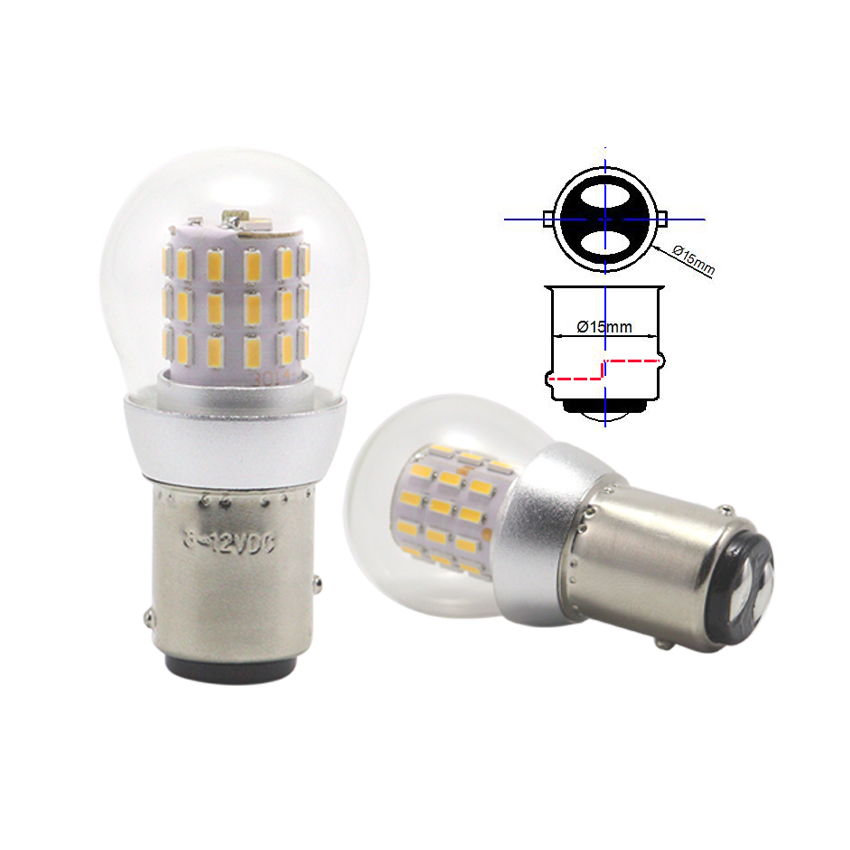
This lamp features an aluminum heat sink and a design similar to traditional halogen lamps, with a 360-degree luminous wick. It also has a glass shade and is IP66 waterproof.
It offers sufficient power without false claims. It's available in multiple voltage ranges.
It utilizes a constant-current IC power supply with a wide-voltage drive design and is CE and RHOS certified.
P21/5W LED Bulbs: Applications and Automotive Brands
The P21/5W is a versatile automotive bulb specification, widely used in modern vehicles for its dual-filament design (supporting two power levels, typically 21W and 5W).
When upgraded to LED technology, these bulbs offer enhanced brightness, lower energy consumption, and a longer lifespan compared to traditional halogen bulbs.
Below is a detailed overview of their application scenarios and the automotive brands that utilize them.
Application Scenarios
The P21/5W LED bulb is primarily used in lighting functions that require dual-intensity output, such as:
•Brake Lights and Tail Lights: The bulb operates at a lower intensity (e.g., 5W) as a tail light (position light) and switches to a higher intensity (e.g., 21W) when the brake is applied.
This provides clear visibility to other drivers, enhancing safety during both day and night driving. The instant illumination of LEDs ensures quicker response times for following vehicles.
•Turn Signals: In some vehicle models, the P21/5W variant (like PY21W) is employed for turn signals. The LED version offers bright, rapid illumination, improving visibility during lane changes or turns.
Its robust design withstands vibrations, making it reliable for frequent use.
•Other Applications: Depending on the vehicle, it can also serve as a reverse light or parking light. The LED upgrade provides a crisp, white light (often 6000K-6500K color temperature),
which improves visibility in low-light conditions and adds a modern aesthetic to the vehicle.
Key advantages of P21/5W LEDs include:
•Energy Efficiency: Consuming as little as 0.5W–1W per bulb, they reduce the load on the vehicle’s electrical system.
•Durability: With a lifespan of up to 50,000 hours and better resistance to shocks, they are ideal
for daily driving.
•Easy Installation: Most designs are plug-and-play, though some modern vehicles may require CANbus-compatible versions to prevent error messages.
Automotive Brands Using P21/5W Bulbs
The P21/5W specification is adopted by numerous automotive brands across different models. The table below summarizes common examples based on vehicle lighting databases:
Car Brand
Example Models Using P21/5W
Typical Application in Vehicle
Volkswagen
Passat Lingyu, Touran, Polo, Golf, Jetta, Sagitar
Brake light, tail light
Audi
A4, A6, A6L
Brake light
Toyota
Corolla, Camry, Prius, Vios
Brake light, tail light
HondaCivic, Accord, CR-V, Fit (Jazz), Odyssey
Brake light, tail light
Ford
Focus, Fiesta, Mondeo
Brake light, tail light
Buick
Excelle, Regal
Brake light, tail light
Hyundai
Elantra, Tucson, Santa Fe
Brake light, tail light
Peugeot/Citroën
206, 307, C2, Elysee
Brake light, tail light
Chinese Brands
BYD F3, Changan Benni, Chery QQ, Geely
Brake light, tail light
Others (e.g., Nissan, Mazda)
Bluebird, Teana, Mazda6
Brake light, tail light
Note: The specific bulb type (e.g., P21/5W, PY21W) may vary slightly in pin configuration (e.g., BAY15D socket for dual-filament), so verifying the vehicle’s manual is recommended for compatibility.
In summary, the P21/5W LED bulb is a critical component in automotive lighting, prized for its reliability and efficiency.
Its adoption by major brands underscores its role in enhancing safety and performance across diverse vehicle models.
Application:
Suitable for small vehicles, trucks, buses, and other vehicles. Used for automotive turn signals, brake lights, taillights, fog lights, daytime running lights, yacht lights, and marine navigation lights.